

How to Choose the Right Fibre Internet for Your SME
March 16, 2026
IT Monitoring Services: How Proactive Monitoring Prevents Downtime and Protects Your Business
May 21, 2026
VoIP is changing how South African SMEs manage communication expenses. By replacing old phone systems with internet-based calling, businesses can save between 30% and 70% on monthly telecom costs. Here’s a quick breakdown of how VoIP helps save money:
- Reduce Call Rates: Calls to local, mobile, and international numbers cost significantly less, with some VoIP providers offering free internal calls and fixed-rate bundles.
- Reduced Hardware Costs: No need for expensive PBX equipment – VoIP works with existing devices like smartphones and computers.
- Included Advanced Features: Features like voicemail-to-email, call recording, and auto-attendants come standard, eliminating extra fees.
- No Line Rentals: VoIP removes the need for physical lines, cutting monthly rental fees for each user.
- Scalable and Easy Maintenance: Adding or removing users is quick, with maintenance and updates included in the service fee.
For a 10-user SME, switching to VoIP can save around R42,600 annually, while also providing modern features at no extra cost. VoIP is a cost-effective solution for businesses looking to streamline communication without compromising quality.
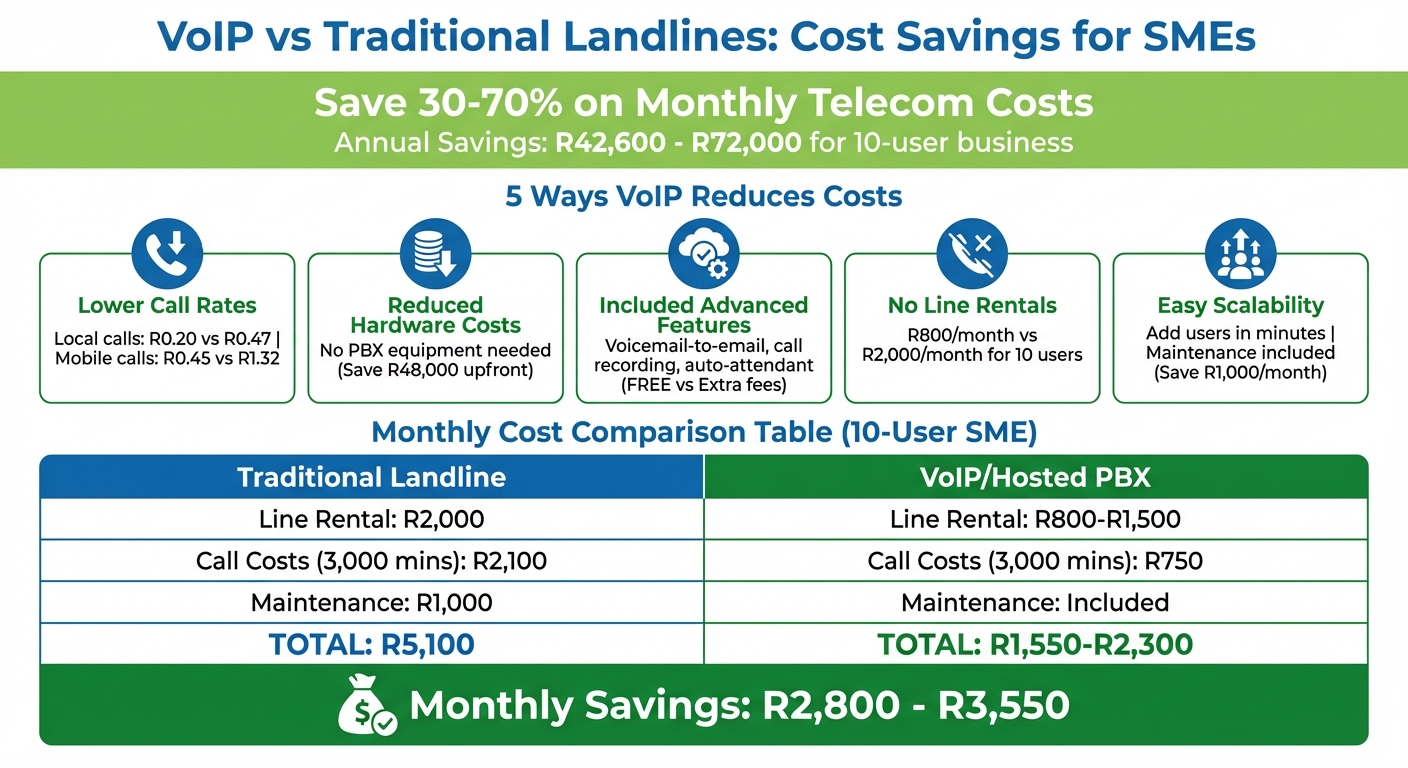
VoIP vs Traditional Landline Cost Comparison for 10-User SME
VoIP Phone Systems Explained: Cut Costs 40% + Boost Productivity | Business Phone Solutions 2026
sbb-itb-e5523aa
1. Lower Call Rates with Unlimited Local and National Calls
Traditional landlines in South Africa typically charge between R0,50 and R1,00 per minute for local and national calls, and R1,00 to R2,50 for calls to mobile numbers. In contrast, VoIP services significantly reduce these costs, with rates ranging from R0,10 to R0,35 for local calls and R0,35 to R0,80 for mobile calls.
This cost difference is largely due to how the systems operate. While older landline systems rely on circuit switching, where a dedicated line is reserved for the entire duration of a call, VoIP uses packet switching. This method only utilises bandwidth during actual audio transmission, making it far more efficient and cost-effective.
Many VoIP providers in South Africa also offer unlimited calling bundles for a fixed monthly fee, which makes budgeting easier. On top of that, VoIP systems often allow free internal calls between branches or extensions – something traditional systems usually charge for. For SMEs with multiple offices or remote teams, these factors can lead to significant savings.
Here’s what industry experts have to say about the cost benefits:
“Calling through a VoIP provider is substantially cheaper. Voys is between 30% – 60% cheaper than Telkom.” – Voys South Africa
Let’s break it down with an example: an SME with 10 users making 3,000 call minutes per month would spend around R2,100 on traditional landlines. With VoIP, the cost drops to about R750, and there’s even more savings by cutting out R150–R250 per user in line rentals.
At Mezobyte, we provide VoIP solutions that include competitive call rates and tailored unlimited calling plans. This allows South African SMEs to take control of their telecom expenses without compromising on quality, making it easier to manage costs while staying connected.
2. Reduced Infrastructure and Hardware Costs
Traditional phone systems come with hefty expenses, especially when it comes to physical hardware. A standard PBX setup typically involves switchboards, servers, and dedicated wiring throughout the office. For a small team of just five people, the upfront costs for hardware, wiring, and installation can reach around R48,000 (approximately $2,605).
VoIP, on the other hand, sidesteps most of these costs by operating entirely in the cloud. It leverages your existing internet connection and local area network, eliminating the need for bulky equipment. Many small businesses adopt a “Bring Your Own Device” (BYOD) strategy, relying on softphone apps installed on smartphones, tablets, or computers they already own. This means your hardware costs can drop to R0 if you’re using devices you already have.
Maintenance is another area where VoIP shines. Traditional systems often require expensive technician visits for repairs or upgrades. VoIP providers handle updates and troubleshooting remotely as part of the subscription service. This shift has allowed South African businesses to reduce telecom costs by an impressive 40% to 70%.
Mezobyte’s 3CX hosted/cloud PBX solution takes this a step further by completely eliminating the need for on-site infrastructure. With everything managed remotely, there’s no need for maintenance call-outs. This lets you focus on growing your business while keeping communication costs consistent and manageable.
3. No Extra Charges for Advanced PBX Features
After saving on hardware costs, VoIP takes cost reduction a step further by including advanced PBX features as part of its standard packages.
With traditional phone systems, every additional feature comes with a price tag. Want an auto-attendant to direct calls? That’s extra hardware. Need voicemail-to-email for a remote team? Another costly upgrade. Looking for call recording for training purposes? Expect to pay for more equipment. VoIP changes all of this by bundling these features into your monthly subscription fee, with no hidden costs or extra upgrades.
Most VoIP providers include features like call forwarding, voicemail-to-email, auto-attendant (IVR), call recording, and even CRM integration as standard in their business-tier plans. As Julia November from WhichVoIP.co.za puts it:
“Most providers offer bundled features – like voicemail-to-email, call recording, mobile apps, and even CRM integration – without extra fees”.
This transparent pricing model means you pay a single monthly fee that covers all the essential tools your business needs. Since everything operates through software, activating new features is as simple as clicking a button in your admin portal.
This setup is especially helpful during load shedding, where features like automatic call forwarding to mobile devices ensure uninterrupted communication without requiring costly backup systems. For instance, Mezobyte’s 3CX hosted PBX solution includes these features, allowing teams to stay productive from the office, home, or on the go – without incurring extra charges for additional features or locations. These built-in capabilities not only simplify operations but also lead to further savings, as we’ll see in the next section on eliminating recurring line rental fees.
4. Elimination of Line Rental Fees
One of the clearest ways VoIP saves money is by cutting out traditional line rental fees entirely. With older phone systems, businesses often spend R150 to R250 per user, per month just to keep those copper lines running. VoIP, on the other hand, uses your existing internet connection to handle voice data.
This shift from paying for physical infrastructure to a user-based pricing model is a game-changer. As Julia November from WhichVoIP.co.za puts it:
“You’re no longer paying for physical lines into your building; you’re paying for a software licence for each person on your team who needs a phone extension.”
The savings from this approach are substantial. Let’s break it down: for a 10-user small business, line rental costs with traditional systems could reach R2,000 per month (R200 × 10 users). With VoIP, hosted PBX licences cost about R800 per month (R80 × 10 users), leading to a monthly saving of R1,200 or R14,400 annually. Add in lower call rates and no maintenance fees, and total monthly costs drop from R5,100 to R1,550, saving R3,550 per month or R42,600 per year. These numbers highlight just how much VoIP can reduce operational expenses for small businesses.
Beyond these direct savings, VoIP’s digital nature brings even more cost efficiency. Since it’s cloud-based, VoIP operates through a digital account rather than a physical connection. This eliminates the need for “rollover lines” to manage multiple calls at once. Plus, with tools like Mezobyte’s 3CX hosted PBX, you can easily add or remove users through a web interface. Even during load shedding, your team stays connected by using mobile apps over LTE data. This flexibility and cost-effectiveness make VoIP an obvious choice for modern businesses.
5. Cost-Effective Scalability and Maintenance
VoIP doesn’t just cut costs on call rates, hardware, and line rentals – it also simplifies growth and keeps maintenance expenses low.
Since VoIP relies on software rather than physical infrastructure, expanding your business becomes a breeze. Need to onboard a new team member? Forget about installing phone lines or waiting for a technician. With VoIP, you can add a user through an online portal, and they’ll be ready to make calls in minutes. This makes it easy to respond to market changes quickly and efficiently.
As Saicom puts it:
“With VOIP, adding more employees to access a company’s call system is a breeze and requires no extra hardware while also having the choice to integrate the current PBX system or get access to a Cloud based PBX system.”
Maintenance is another area where VoIP shines. Traditional systems often rack up hefty technician fees – anywhere from R500 to R1,500 per call-out. VoIP, on the other hand, includes maintenance and updates in a single monthly fee. For a business with 10 users, this can save about R1,000 per month. Plus, updates and troubleshooting are handled remotely, eliminating the need for costly on-site visits.
VoIP also supports a “bring your own device” (BYOD) approach, or you can opt for budget-friendly IP phones, which cost around R800 each as a one-off investment.
With Mezobyte’s 3CX hosted PBX, scaling your team – whether you’re growing, downsizing, or accommodating seasonal staff – is just a matter of a few clicks. There’s no need for hardware upgrades or complex rewiring. This adaptability is especially crucial in South Africa’s fast-changing business environment, where companies need communication systems that can keep up with evolving strategies.
Comparison Table
The tables below highlight the cost differences between VoIP and traditional telecommunication systems, using real South African pricing as a reference.
Per-Minute Call Rate Comparison (ZAR)
| Destination | Traditional Landline (Peak) | Typical VoIP Rates |
|---|---|---|
| Local / National | R0,47 | R0,20 – R0,46 |
| Mobile | R1,32 | R0,45 – R0,90 |
| International (UK/USA) | High / Variable | ~R0,40 – R0,50 |
| On-Network | Package dependent | Free |
VoIP’s advantage is particularly noticeable with mobile call rates, where costs can be slashed by over 50%. Plus, free on-network calls mean that internal communication between colleagues or branches costs absolutely nothing.
Monthly Infrastructure & Service Comparison (10-User SME Example)
| Expense Category | Traditional Landline (Estimated) | VoIP / Hosted PBX (Estimated) |
|---|---|---|
| Monthly Service/Rental | R2 000 (Line rental) | R800 – R1 500 (Licences) |
| Call Costs (3 000 mins) | R2 100 | R750 |
| Maintenance & Support | R1 000 | Included in monthly fee |
| Total Monthly Cost | R5 100 | R1 550 – R2 300 |
| Potential Savings | – | R2 800 – R3 550 per month |
For a 10-user SME making around 3 000 minutes of calls each month, the savings are clear: between R2 800 and R3 550 per month. That’s money that could be channelled into business growth instead of being spent on outdated systems. These savings are further amplified by the added value VoIP systems provide through built-in features.
Feature Cost Comparison
| Feature/Expense | Traditional Landline (Telkom) | VoIP / Cloud PBX |
|---|---|---|
| Monthly Line Rental | R262,28 | R65,00 – R159,95 |
| Call Hunting | R16,05 per line | FREE |
| Caller ID (CLI) | R8,64 per line | FREE |
| Advanced Features (IVR, TMS) | Extra Hardware/Fees | Included in licence |
Traditional systems often charge extra for basic features like call hunting and caller ID. In contrast, VoIP services include these at no additional cost. With Mezobyte’s 3CX hosted PBX, you also gain access to advanced tools like IVR and call monitoring, features that would require costly hardware upgrades on traditional platforms. These comparisons illustrate how VoIP can dramatically cut communication expenses while delivering more functionality for SMEs.
Conclusion
VoIP is reshaping how South African SMEs communicate by replacing expensive, outdated telecom systems. For a small business with 10 users, this shift can lead to annual savings ranging from R48,000 to R72,000.
Many South African companies are already seeing these benefits. These savings aren’t just numbers – they’re funds that can be redirected towards growth, staff training, or acquiring new customers, rather than being tied up in maintaining old phone systems.
Mezobyte offers tailored cloud-hosted VoIP solutions and 3CX integration specifically for South African SMEs. Alongside these services, they provide expert IT support to ensure smooth implementation and dependable performance. Their solutions also address local challenges like loadshedding by offering features such as mobile app failover and cloud-based resilience.
VoIP goes beyond cutting costs – it’s a forward-looking investment. It delivers immediate financial benefits while preparing your business for the future, especially as South Africa’s fibre and 5G networks continue to grow.
FAQs
What internet speed do I need for VoIP?
For dependable VoIP call quality, you’ll need at least 100 kbps per active call. Fibre internet is the best option since it delivers steady and reliable performance, making it perfect for business communication. Make sure your internet connection can support multiple calls at the same time without sacrificing quality.
Will VoIP work during load shedding?
VoIP services can still work during load shedding, but you’ll need a reliable alternative power source, like a backup generator or an uninterruptible power supply (UPS). Since VoIP depends on internet connectivity rather than the traditional power grid, keeping your modem, router, and VoIP devices powered is essential for uninterrupted communication.
Can I keep my current business phone numbers?
Yes, you can keep your current business phone numbers when moving to a VoIP provider in South Africa. Through number porting, your existing numbers can be transferred to the new provider seamlessly. This means your business communications can continue uninterrupted, ensuring your clients and partners can still reach you as usual.


