How to Reduce Call Rates by Using 3CX
February 16, 2026
5 Ways VoIP Reduces Communication Costs for SMEs
April 17, 2026
How to Choose the Right Fibre Internet for Your SME
Looking for reliable internet for your SME? Here’s the short answer: Fibre internet is your best bet. It offers faster speeds, better reliability, and scalability compared to outdated ADSL. By 2026, 78% of SMEs in South Africa rely on tools like VoIP, cloud apps, and video conferencing, making fibre an essential upgrade.
Key Takeaways:
- Start with your needs: Calculate bandwidth based on team size and tools (e.g., video calls need 3–10 Mbps per session).
- Choose wisely: Fibre to the Business (FTTB) offers dedicated lines, better speeds, and SLAs, while Fibre to the Home (FTTH) is cheaper but shared.
- Plan for growth: Opt for scalable packages that allow bandwidth upgrades without new installations.
- Budget smartly: Costs range from R315/month for basic plans to R16,999/month for high-speed dedicated lines.
Pro Tip: Always check SLAs for uptime guarantees and compare providers’ reputations for reliability and support.
Fibre internet isn’t just faster; it’s more consistent, secure, and future-proof for SMEs. Keep reading to learn how to pick the perfect plan for your business.
Determining Your Bandwidth and Speed Needs
Calculating Your Bandwidth Requirements
To figure out your bandwidth needs, start by identifying your peak usage hours – usually between 10 AM and 1 PM. During this time, count the number of employees online, the video calls happening, and the cloud apps in use. Record this data and calculate the combined bandwidth demands for all applications.
Here’s a quick guide to common bandwidth usage:
- Basic web browsing and email: 1–3 Mbps per user.
- HD video conferencing: 3–10 Mbps per session.
- Remote desktop connections: 3–5 Mbps per session, or up to 10–15 Mbps for high-quality Virtual Desktop Infrastructure.
- Cloud tools (e.g., Microsoft 365, Google Workspace): 1–3 Mbps per active user.
Once you’ve added up these needs, include a 20% buffer to account for network protocols, VPN encryption, and background updates. If your business plans to use AI-powered tools like Microsoft Copilot by 2026, increase this buffer to 30% to handle the additional data load.
To identify potential bottlenecks, run speed tests on Ethernet-connected devices at 10 AM, 1 PM, and 3 PM. For smooth performance with real-time applications like VoIP, ensure jitter is under 10 ms and there’s no packet loss. Also, plan ahead for 12–18 months of growth, as fibre installations can require 4–12 weeks to complete.
Once you’ve mapped out your usage, compare it against the fibre packages available in your area.
Fibre Speed Options for SMEs
Match your calculated needs to the right fibre plan. In South Africa, fibre packages typically range from 20 Mbps to 1,000 Mbps (1 Gbps), with prices varying by speed tier. Entry-level plans offering 20–40 Mbps start at around R315 per month. For small to medium-sized enterprises (SMEs), speeds between 50 and 100 Mbps are often ideal. Greg Wright, Head of Communications at Mweb and Webafrica, highlights that “the ISPs regard around 50 Mbps to be the sweet spot for a small business”.
Here’s a breakdown of typical requirements:
- 5–10 employees: For activities like email, light cloud work, and 1–2 video calls, 50–100 Mbps download and 25–50 Mbps upload will suffice.
- 10–20 employees: To manage multiple video calls, SaaS tools, and file transfers, aim for 150–250 Mbps download and 50–100 Mbps upload.
- Heavy data users: Businesses handling large file transfers, CAD software, or video rendering may need 500+ Mbps download and 250+ Mbps upload, regardless of team size.
Mid-tier plans offering 50–100 Mbps typically cost between R619 and R1,725 per month. Higher-end dedicated lines, ranging from 200 Mbps to 1 Gbps, are priced anywhere from R2,198 to R16,999 per month. Keep in mind that actual speeds often deliver 80–95% of the advertised rates, so adjust your expectations accordingly.
For businesses relying on cloud backups, video conferencing, or real-time collaboration tools, prioritise symmetrical connections (equal upload and download speeds) to ensure smooth operations.
sbb-itb-e5523aa
Why fiber optic internet is critical for business growth
Types of Fibre Internet and Package Options
FTTB vs FTTH: Business Fibre Comparison for SMEs
FTTB vs FTTH: Which One Suits Your Business?
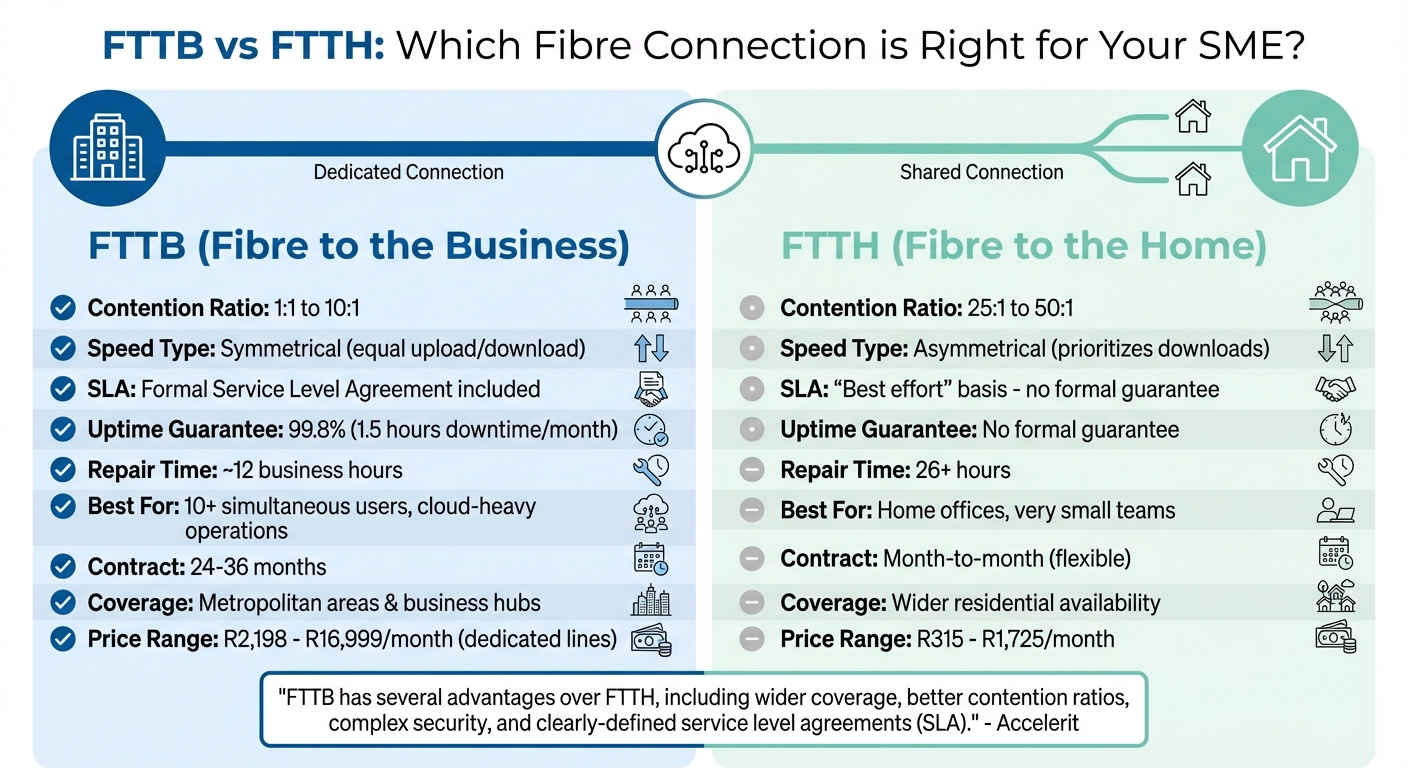
For SMEs aiming to scale, choosing the right fibre connection is crucial. Fibre to the Business (FTTB) offers a dedicated line with contention ratios ranging from 1:1 to 10:1, ensuring stable speeds even during peak periods. In contrast, Fibre to the Home (FTTH) is a shared service, with contention ratios typically between 25:1 and 50:1.
FTTB is designed for businesses needing symmetrical speeds, which are essential for tasks like cloud backups, VoIP calls, and video conferencing. FTTH, on the other hand, often prioritises download speeds over uploads, making it less suited for data-heavy business activities. Another key difference is that FTTB comes with a formal Service Level Agreement (SLA), guaranteeing uptime and repair times. FTTH services are generally offered on a “best effort” basis, with no such guarantees.
“FTTB has several advantages over FTTH, including wider coverage, better contention ratios, complex security, and clearly-defined service level agreements (SLA).” – Accelerit
For SMEs with over 10 simultaneous users or those relying heavily on cloud tools, FTTB is usually the better option. FTTH works well for home offices or very small teams with minimal connectivity needs. Be aware that FTTB contracts often require 24- to 36-month commitments due to installation costs, while FTTH is frequently available on more flexible, month-to-month terms. Coverage can also be a deciding factor – FTTB is often concentrated in metropolitan areas and business hubs, so check availability with providers like Vumatel or Openserve.
Understanding these differences is the first step. Next, align these technical details with your business goals by reviewing available packages.
Choosing Between Fibre Packages
Once you’ve identified the right fibre type, the next step is comparing packages to find the best fit for your budget and performance requirements. In South Africa, most business fibre packages are uncapped, but some providers may throttle speeds after reaching a usage threshold. Always check the provider’s fair usage policy. For businesses relying on VoIP or video conferencing, unshaped plans are ideal as they don’t limit high-priority activities.
Symmetrical connections are especially valuable for teams that frequently upload large files, perform cloud backups, or host virtual meetings. For example, Vox Business Fibre offers uncapped plans priced between R799 and R3,399 per month, while their Dedicated Fibre option – featuring a 1:1 contention ratio – ranges from R2,198 to R16,999 per month. Similarly, Telkom‘s Business Core Fibre provides uncapped data at speeds of 50–100 Mbps, starting at R619 per month.
If your business requires a static IP address for hosting servers or managing advanced security systems, ensure this feature is included in your package. Static IPs are standard with FTTB but less common with FTTH. Also, opt for a provider that allows seamless bandwidth upgrades. This ensures your internet can grow with your business without needing a fresh installation.
The next section will explore how reliability, SLAs, and the reputation of providers can impact your fibre internet choice.
Reliability, SLAs, and Provider Reputation
Uptime Guarantees and Reliability
Once you’ve chosen a fibre plan that meets your bandwidth needs, the next priority is ensuring consistent and dependable service. For SMEs relying on VoIP systems and cloud-based tools, uptime is non-negotiable. Downtime doesn’t just disrupt operations – it directly impacts revenue. Your fibre connection should be up and running during critical business hours, whether for customer interactions, backups, or peak operations. Business-grade fibre typically promises 99.8% uptime, which equates to about 1.5 hours of downtime per month – manageable for most businesses. However, if your operations demand uninterrupted connectivity, you may need 100% uptime with automatic failover solutions.
This is where the distinction between FTTB (Fibre to the Business) and FTTH (Fibre to the Home) becomes evident. Unlike FTTB, FTTH doesn’t come with formal uptime guarantees. FTTB services often include specific uptime commitments and repair timelines. For example, Vumatel guarantees a minimum unplanned network availability of 95% over 12 months. Additionally, look for providers offering proactive network monitoring and automated alerts to minimise disruptions.
What to Look for in Service Level Agreements
An SLA (Service Level Agreement) isn’t just a promise – it’s a binding document that outlines how issues will be handled. Pay close attention to the Mean Time to Repair (MTTR). Some SLAs only account for business hours (e.g., 07:30 to 16:30), which could delay repairs for businesses operating outside these hours. For FTTB connections, repair times are generally around 12 business hours, whereas FTTH repairs can take 26+ hours. Openserve Premium Connect, for instance, offers an 8-business-hour repair SLA specifically for business fibre.
The SLA should also categorise issues by severity, ensuring immediate action for major outages and setting clear timelines for resolving minor issues. Service credits should be included if the provider fails to meet these targets. Additionally, business-grade services often come with lower contention ratios, which means less bandwidth competition.
These SLA specifics form the foundation for assessing a provider’s reliability, which ties into the next step: evaluating their reputation.
Checking Provider Reputation and Support Quality
While technical guarantees are essential, the real-world performance of a provider can make or break your operations. Before committing to a contract, take the time to research how providers perform under actual conditions. The ISPA Fibre Network Operators Survey (February 2025) offers valuable insights: Openserve scored 8.4/10 for reliability, Octotel earned 7.7/10 for reliability and 7.5/10 for support, while Vumatel received lower ratings of 5.7/10 for reliability and 4.4/10 for support.
Online platforms like HelloPeter, Google Reviews, and Trust Pilot can provide additional customer feedback. It’s also a good idea to confirm that your ISP is a member of the Internet Service Providers’ Association (ISPA), which offers mediation and complaint resolution services. For a more local perspective, ask neighbouring businesses about their experiences, as infrastructure quality can vary widely depending on the area.
Lastly, test the provider’s support quality before signing. Call their support centre to gauge response times and assess the technical knowledge of their team. Providers with 24/7/365 support and dedicated field technicians will typically resolve issues faster than those relying on generic call centres.
“The vast majority of SLAs have no consequences if the FNO or ISP offering them fails to meet the SLA, meaning that they are really nothing more than a nonbinding estimate of expected fault resolution times.” – ISPA
Cost, Scalability, and Business Requirements
Fibre Internet Pricing for SMEs
When selecting a fibre package, it’s not just about the price tag – it’s about finding a solution that fits your current needs while leaving room for future growth.
In South Africa, fibre pricing depends on factors like speed, provider, and connection type. Entry-level packages, ideal for startups with modest requirements, range from R315 to R335 per month for speeds of 20–40 Mbps, although upload and download speeds are often uneven. For growing SMEs that need better reliability and symmetrical speeds, mid-tier business packages cost between R619 and R1,460 per month for 50–100 Mbps. If your business relies heavily on data – think video conferencing or cloud services – you should expect to pay R1,449 to R3,399 per month for speeds of 200–500 Mbps.
Before diving into ISP comparisons, check which Fibre Network Operator (FNO) serves your area – options like Openserve, Vumatel, or MetroFibre influence the base cost. Also, factor in additional expenses like setup fees, router costs, and any potential cancellation penalties.
Once you’ve got a clear picture of the costs, it’s time to evaluate how well the service can scale as your business grows.
Selecting Solutions That Grow With Your Business
Scalability is just as important as cost. Fibre is inherently scalable, and most providers allow you to upgrade your bandwidth without needing new physical installations. The trick is to choose a provider that offers flexible upgrade options while maintaining low contention ratios. For instance, business-grade fibre typically operates on an 8:1 contention ratio, ensuring more consistent performance compared to residential lines, which can go as high as 20:1 or worse.
“Fibre networks are built to handle massive amounts of data and are capable of being upgraded as technology advances… fibre can scale effortlessly.” – Faircom
As your business incorporates more advanced tools – like cloud services, AI-driven applications, or IoT devices – your bandwidth needs will grow. A business with five or more devices handling demanding tasks like 4K streaming or video calls should start with speeds of at least 100–200 Mbps. Providers like Mezobyte offer high-speed fibre solutions designed to adapt to these evolving demands. Additionally, ensure your provider offers coverage in multiple areas and guarantees at least 99% uptime, as downtime becomes increasingly costly as your operations expand.
Conclusion
Key Considerations for Choosing Fibre Internet
When selecting fibre internet for your SME, there are four primary factors to keep in mind.
- Speed that matches your needs: For most small businesses with up to 50 users, a 50 Mbps connection is often sufficient. However, if your operations include frequent cloud-based tasks or video conferencing, you’ll benefit from symmetrical speeds.
- Reliability through SLAs: Always opt for service providers that guarantee at least 99% uptime and offer an 8-hour fault resolution timeframe.
- FTTB over FTTH: Whenever possible, go for Fibre to the Business (FTTB) instead of Fibre to the Home (FTTH). Business-grade fibre offers dedicated connections, lower contention ratios (8:1 compared to 20:1 for residential), and more robust support.
- Scalability: Fibre networks are built for growth. They allow bandwidth upgrades without requiring new physical installations. Choose a provider that offers flexible options to accommodate your business’s future needs.
Additionally, ensure you select uncapped, unshaped plans that can grow with your business seamlessly. These steps lay the groundwork for a more reliable and efficient internet experience.
Steps to Boost Your SME’s Connectivity
If you’re still relying on outdated ADSL or dealing with inconsistent speeds, it’s time to make the switch. Fibre internet can deliver speeds up to 50 times faster than traditional connections, giving your business the performance it needs to thrive both now and in the future.
Start by conducting a detailed audit of your current internet usage. Count the number of devices connected at the same time, pinpoint activities that consume the most bandwidth, and estimate user growth over the next year or two. Once you have a clear picture, contact Mezobyte for tailored business fibre solutions. Look for packages that include around-the-clock support, which is a step above the standard consumer-grade helpdesk hours. Also, check if they offer static IP addresses, which can be essential for certain business operations.
“A key benefit of fibre for SMEs is that it enables SMEs to operate online without any of the performance and quality constraints they may have faced before.” – Arthur Goldstuck, Principal Researcher, SME Survey
Investing in the right fibre solution sets the stage for uninterrupted connectivity, improved productivity, and long-term growth for your SME.
FAQs
Do I need a failover internet line?
Whether or not your business needs a failover internet line boils down to how crucial uninterrupted connectivity is for your operations. If you’re running an SME that relies heavily on online tools, cloud-based services, or real-time communication, a failover line can help reduce downtime during outages caused by load shedding or infrastructure problems. For businesses where constant internet access is non-negotiable, having a backup line can keep things running smoothly. On the other hand, if your connectivity needs are minimal, sticking with a primary line might be enough.
Will my Wi-Fi setup bottleneck fibre speeds?
Yes, your Wi-Fi setup can affect your fibre speeds. If your router is outdated, placed in a poor location, or not configured correctly, it can slow things down. Other factors, like walls, furniture, or even nearby electronics, can interfere with the signal. To get the best speeds, ensure your router is positioned well (like in a central, open spot), use up-to-date equipment, and reduce interference from other devices or obstacles.
Is a static IP necessary for my SME?
For most SMEs, having a static IP address isn’t a must-have, but it can be quite helpful for certain scenarios. Businesses that host their own servers, require remote access, or rely on specific cloud-based applications may find a static IP simplifies configuration and boosts security.
For everyday activities like sending emails or browsing, a dynamic IP address works just fine. However, a static IP comes with perks like easier remote access, stronger VPN compatibility, and enhanced email deliverability. These features make it a solid choice for SMEs with more advanced networking requirements.