

How South African Businesses Can Reduce Microsoft 365 Licensing Costs
July 7, 2026
The Importance of Preventive IT Maintenance for South African Businesses
August 17, 2026
If your internet drops, your business slows down. For many South African SMEs, that can mean lost sales, poor call quality, delayed work, and downtime that costs R1 000 to R10 000 per hour.
I’d sum it up like this: if your team uses Microsoft 365, VoIP, cloud apps, card payments, or hybrid work tools, then your connection is part of how the business runs day to day. Weak internet leads to slow uploads, choppy calls, sync issues, peak-time slowdowns, and more risk when staff fall back on personal hotspots.
Here’s the short version:
- Poor connectivity costs money through downtime, missed work, and weaker customer service
- Growing teams hit limits fast as more staff, devices, and cloud tools share one line
- Business fibre handles daily work better with low latency, steady speeds, stronger upload performance, and SLA-backed uptime
- LTE still has a place, but mostly as a backup option rather than the main business line
- The best setup is often business fibre with automatic LTE failover for backup
Quick comparison
| What matters | Business fibre | Fixed LTE |
|---|---|---|
| Latency | Low, often around 5 ms to 15 ms | Higher, often around 30 ms to 70 ms |
| Upload speed | Strong and balanced | Lower than download speed |
| Peak-time slowdowns | Low or limited | More common |
| VoIP and video calls | Clearer and more stable | More likely to lag or jitter |
| Uptime terms | Usually backed by SLA | Usually best-effort |
| Best fit | Main business connection | Backup or mobile use |
Bottom line: if you want cloud tools, calls, payments, and staff workflows to keep moving during the workday, business fibre is the safer choice for growth.
sbb-itb-e5523aa
How unstable internet holds business growth back
Unreliable internet chips away at revenue, customer service, and your ability to take on more work. It usually doesn’t fail in one dramatic moment. Instead, it shows up as small delays and repeated interruptions that stack up over time. The end result is slower work, weaker service, and less room to grow.
What downtime and slow speeds actually disrupt
When a connection drops or drags, the effects spread fast. A CRM system becomes unavailable during a call. A cloud accounting platform refuses to load while a client is waiting. A card machine goes offline at the till. Every one of those moments carries a direct cost: lost sales, wasted staff time, or a customer who simply walks away.
Latency, which is the delay between sending and receiving data, hits VoIP calls and video meetings especially hard. Once it goes above 30 ms, calls start to pick up echoes and audio lag, and video turns choppy. Fibre usually delivers latency between 5 and 15 ms, which helps keep real-time communication clear and steady.
Peak-time bandwidth sharing brings another problem. Shared residential-grade connections often slow down during business hours, when everyone is online at once, which is exactly when your team needs stable access most.
Downtime, high latency, peak-time slowdowns, and weak upload speeds all eat into sales, service quality, and staff output.
Why growing teams hit connectivity limits faster
As teams grow, the strain gets worse. More staff, more devices, and more cloud use all add pressure to the same connection. Upload speed is where many growing businesses get caught short. Sending files to a client, saving documents to the cloud, and running video calls all depend on solid upload performance. Asymmetric connections, which offer far lower upload speeds than download speeds, often can’t keep up as team size and cloud usage increase.
This isn’t just about the top speed on a package. It’s about steady performance during business hours. That’s the pressure business fibre is built to ease.
Why business fibre works better for South African SMEs
Business fibre fixes the day-to-day problems that get in the way of cloud work, calls, and customer service. It’s built for business traffic, not home use.
Consistent speed, uptime, and performance your business can rely on
Balanced upload and download speeds help keep VoIP, video calls, and cloud sync steady. That matters during business hours, when tools like Microsoft 365, VoIP, and file sharing all need to run at the same time without slowing each other down.
Business fibre also tends to face less congestion when networks are busy. So performance stays more stable, latency stays low, and services can support 99,99% uptime targets.
Another big difference is the Service Level Agreement (SLA). This is a written commitment from your provider that sets out uptime and repair times. Residential connections are usually sold on a best-effort basis, which is a very different deal.
That gap stands out even more when you compare fibre with LTE.
How fibre scales as your business grows
Fibre is easier to scale as your business grows. In many cases, an upgrade is just a package change, so you can move from a lower tier to a higher one with little disruption.
That makes it a neat fit for businesses that grow in steps instead of all at once.
As you add staff, IP phones, cloud storage, and hybrid work setups, fibre can keep up without forcing you to rebuild the network each time. You add capacity as needed, and the connection keeps pace with the business.
For mobile or backup use, the next step is to look at where fibre still has the edge over LTE.
Where fibre outperforms LTE for business use
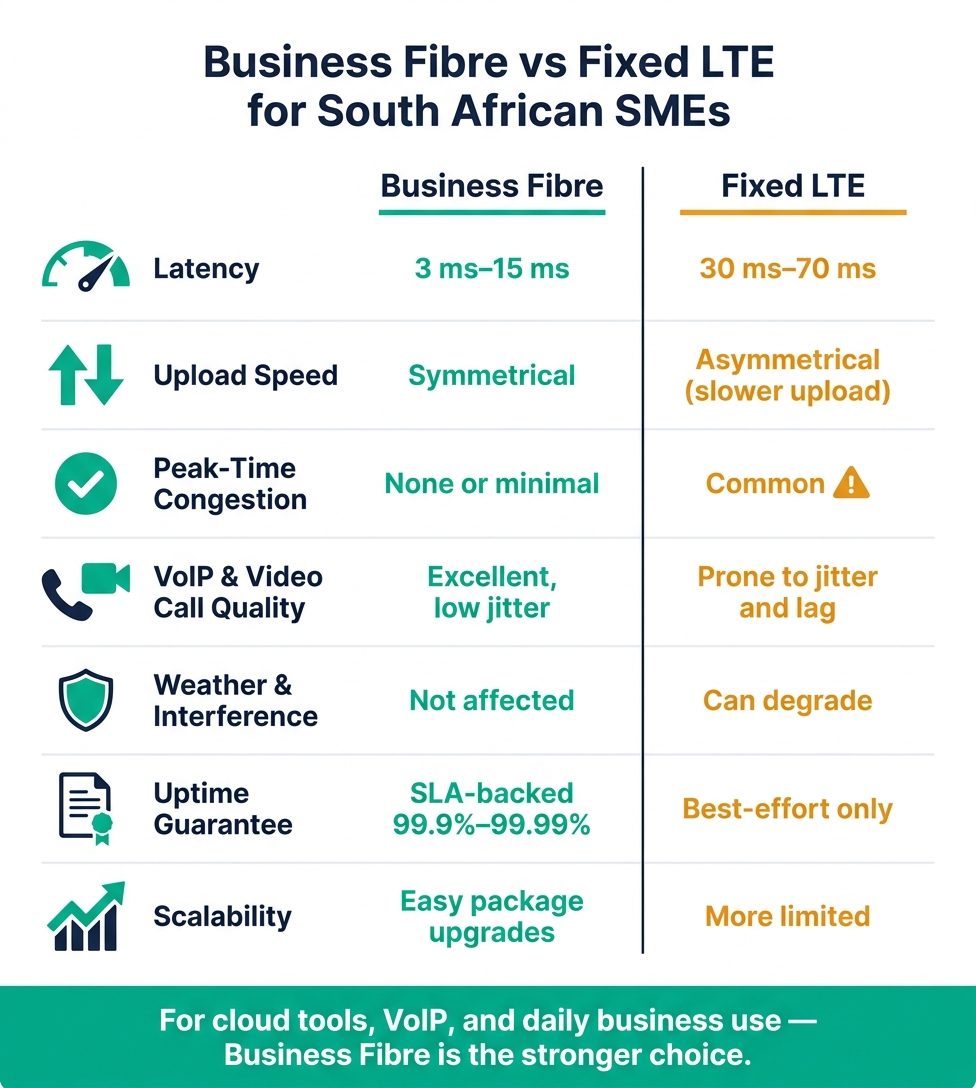
Business Fibre vs Fixed LTE: Key Performance Differences for South African SMEs
Spec-sheet speeds don’t tell the full story. Fibre and LTE can seem close on paper, but day-to-day use is where the gap shows. LTE often slows when several staff members are on calls, syncing files, or working in cloud apps at the same time. For growing South African SMEs, that starts to hurt pretty fast as more people, more tools, and more calls all lean on the same connection.
Fibre vs LTE: uptime, stability, and daily business use compared
In practice, the biggest differences come down to three things: upload speed, latency, and how well the connection holds up under load.
LTE is usually asymmetrical, which means upload speeds are much slower than download speeds. That can choke cloud work and make VoIP calls less stable.
Latency is another clear divide. Fibre will often deliver latency of under 3 ms to 15 ms, while fixed LTE commonly lands between 30 ms and 70 ms. You feel that gap in Microsoft 365, CRM access, and video meetings. It’s the difference between a system that responds straight away and one that feels just a bit off.
LTE also shares tower capacity, so speeds can dip during busy periods. Fibre runs over a dedicated line, so performance tends to stay more even.
| Factor | Business Fibre | Fixed LTE |
|---|---|---|
| Latency | Very low | Higher |
| Upload speed | Symmetrical | Usually asymmetrical |
| Peak-time congestion | None or minimal | Common |
| VoIP and video call quality | Excellent | More prone to jitter |
| Weather and interference | Not affected | Can degrade |
| Uptime guarantee | Strong SLA-backed reliability | Usually best-effort |
| Scalability | Easy to upgrade as the business grows | More limited |
These gaps matter most when the connection needs to carry Microsoft 365, VoIP, and backup connectivity at the same time.
How the right fibre setup supports cloud tools, VoIP, and business continuity
That technical edge matters most when your connection has to handle the tools your business uses every day, without falling over halfway through the job.
Better Microsoft 365, cloud access, and VoIP performance
You notice the difference fast when your team works in Microsoft 365, uses VoIP, and opens cloud files all day. OneDrive and SharePoint sync faster, Teams calls stay clear, and cloud apps run more smoothly.
For customer-facing teams, low jitter and steady latency make a big difference. Voice and video stay clear, which means fewer awkward pauses, less talking over each other, and a better experience for the person on the other side. On a consumer-grade connection, VoIP quality can dip at the worst time – and clients hear every crackle, delay, or dropped word.
Once the main connection is stable, the next job is making sure the business can stay online if that line goes down.
Backup connectivity, network security, and hybrid work support
Business continuity depends on more than one fibre line doing its job. Even a good connection can fail. Pair fibre with automatic LTE failover through a dual-WAN or SD-WAN setup, and traffic can switch between links in seconds – often fast enough to keep calls connected during failover.
The same thinking matters for hybrid and remote teams. Managed security, firewall control, and monitoring help keep staff connected and protected, while the business keeps working without extra disruption.
Conclusion: Choosing the right connectivity is a business decision
Poor connectivity hits a business where it hurts most: revenue, productivity, and reputation. And as teams grow, software stacks get heavier, and customer expectations climb, that pressure spreads across the whole business – from customer service to finance.
That’s why the connection itself needs to be built for business use, not home use. Business fibre gives you steadier speeds, stronger uploads, and more predictable performance during working hours. Dedicated bandwidth helps keep speeds steady when demand is high. Balanced upload and download speeds help cloud tools, VoIP, and video calls run smoothly. And SLA-backed uptime guarantees – usually 99,9% to 99,99% – offer a level of reliability that residential-grade connections just can’t match.
The real issue is simple: can your current connectivity support business growth?
Scalability matters here. Business fibre makes it easier to upgrade bandwidth without installing new hardware. Pair that with automatic LTE failover, and the business can stay online during outages.
For South African businesses that rely on cloud tools, serve customers daily, or support hybrid teams, the right fibre setup helps keep work on track, customers looked after, and growth steady.
FAQs
How much fibre speed does my business need?
The right speed comes down to how many people are using the connection and how heavy the daily workload is.
As a general guide:
- 5 to 10 users will usually need 20 Mbps to 50 Mbps
- 10 to 50 users will usually need 50 Mbps to 200 Mbps
- Larger businesses, call centres, or teams with more than 40 users should look at 200 Mbps to 1 Gbps or more
It also helps to leave 30% to 50% extra capacity for busy periods. That buffer can make a big difference when everyone is online at once, on calls, sending files, or using cloud tools at the same time.
When should I use LTE as a backup?
Use LTE as a secondary backup connection to help keep your business online during a fibre outage. It’s a solid automatic failover option when your main fibre line drops.
LTE can also work well as a temporary fix before fibre is installed, or in areas where fibre still isn’t available. For the best setup, pair it with a dual-WAN or SD-WAN router so failover happens automatically.
What does an SLA cover?
A Service Level Agreement (SLA) is a formal contract between your business and your provider that sets out the service and support standards you should expect.
It usually covers uptime – for example, 99.9% availability – along with speed, performance, and support commitments like fault response and resolution times. It may also spell out compensation or service credits if those standards aren’t met.


