

Business Fibre in South Africa: Why Every Growing Business Needs Reliable Connectivity
July 17, 2026
For many businesses, IT maintenance only becomes a priority when something goes wrong. A server crashes, emails stop working, or employees are unable to access critical systems. While fixing these issues quickly is important, reacting after a problem occurs often results in unnecessary downtime, lost productivity and unexpected costs.
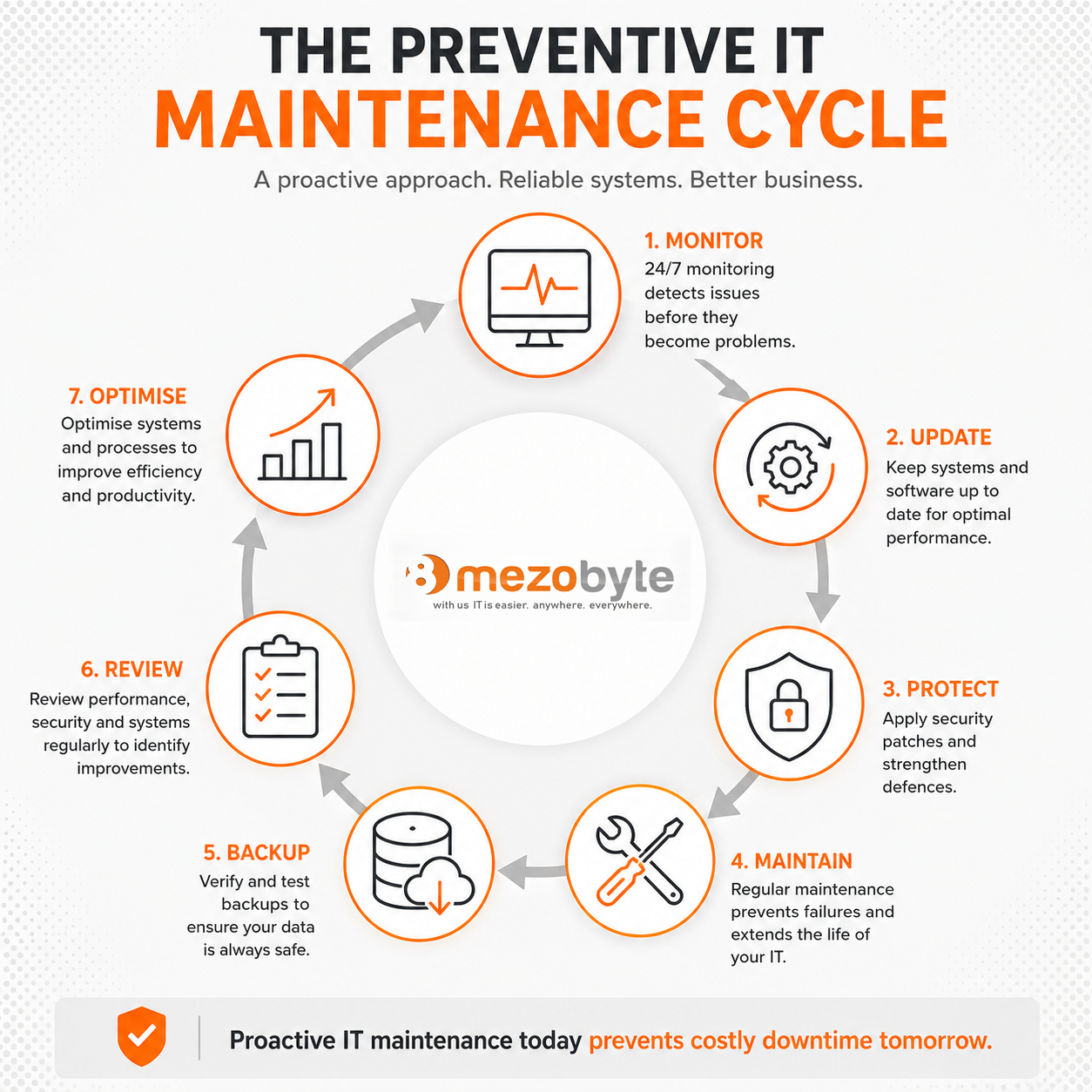
Preventive IT maintenance takes a different approach. Instead of waiting for problems to arise, it focuses on keeping your systems healthy through regular monitoring, updates and maintenance. This proactive strategy helps businesses reduce disruptions, improve security and extend the lifespan of their technology.
Whether you’re a small business with a handful of employees or a growing company managing multiple locations, investing in preventive IT maintenance can save both time and money in the long run.
What Is Preventive IT Maintenance?
Preventive IT maintenance is the ongoing process of monitoring, maintaining and optimising your IT systems before problems occur.
Rather than responding to emergencies, IT professionals perform regular checks to ensure your infrastructure continues operating efficiently.
Typical preventive maintenance includes:
- Monitoring servers and workstations
- Installing operating system and software updates
- Applying security patches
- Checking backup systems
- Testing disaster recovery procedures
- Monitoring storage capacity
- Reviewing system performance
- Replacing ageing hardware before it fails
- Removing unnecessary software
- Verifying antivirus and endpoint protection
The goal is simple: identify and resolve potential issues before they impact your business.
Why Preventive IT Maintenance Matters
Technology supports almost every aspect of modern business. Even a short period of downtime can affect customer service, staff productivity and revenue.
A proactive maintenance strategy helps businesses minimise these risks while ensuring systems remain secure, reliable and efficient.
Let’s look at some of the key benefits.
1. Reduce Expensive Downtime
Unexpected IT failures rarely happen at a convenient time.
A failed hard drive, corrupted software update or overloaded server can bring an entire business to a standstill.
Preventive maintenance helps identify warning signs early, allowing issues to be resolved before they become major disruptions.
Less downtime means:
- Employees remain productive.
- Customers receive uninterrupted service.
- Critical systems stay available.
- Businesses avoid emergency repair costs.
2. Improve Cybersecurity
Cyber threats continue to evolve, making regular maintenance more important than ever.
Many successful cyber attacks exploit outdated software or unpatched vulnerabilities.
Preventive maintenance includes:
- Security updates
- Patch management
- Antivirus monitoring
- Firewall reviews
- User account audits
- Endpoint protection checks
Keeping systems updated significantly reduces the risk of ransomware, malware and other cyber threats.
3. Extend the Life of Your Hardware
Replacing servers, laptops and networking equipment is expensive.
Routine maintenance helps maximise the lifespan of existing hardware by:
- Monitoring hard drive health
- Cleaning unnecessary files
- Managing storage usage
- Identifying failing components early
- Preventing overheating
- Keeping firmware updated
Businesses often avoid premature hardware replacements simply by maintaining their equipment properly.
4. Improve System Performance
Slow computers frustrate employees and reduce productivity.
Preventive maintenance helps ensure systems continue operating at their best by:
- Removing temporary files
- Optimising startup processes
- Updating drivers
- Monitoring memory usage
- Reviewing storage capacity
- Identifying software conflicts
Even small performance improvements across multiple employees can save many hours each month.
5. Protect Your Business Data
Data is one of your business’s most valuable assets.
Regular maintenance ensures backups are not only running but also working correctly.
This includes:
- Backup monitoring
- Backup testing
- Storage verification
- Recovery testing
- Retention reviews
A backup that has never been tested may not work when you need it most.
6. Lower Long-Term IT Costs
Some businesses delay maintenance to save money.
Ironically, this often results in higher costs later.
Emergency call-outs, hardware failures, data recovery and extended downtime typically cost far more than regular maintenance.
Preventive IT maintenance helps businesses:
- Reduce emergency repairs.
- Avoid unnecessary equipment replacements.
- Prevent costly security incidents.
- Budget more effectively for future upgrades.
Proactive maintenance is an investment rather than an expense.
7. Support Business Growth
As your business grows, so do the demands on your IT infrastructure. Adding new employees, opening additional offices or introducing cloud-based applications can quickly place extra strain on your systems.
Preventive IT maintenance helps ensure your technology can grow alongside your business. Regular reviews identify when upgrades are needed, allowing you to plan ahead instead of reacting to performance issues or unexpected failures.
Scalable IT infrastructure enables your business to expand with confidence while avoiding unnecessary disruption.
8. Improve Employee Productivity
Few things are more frustrating than slow computers, unreliable internet connections or software that crashes regularly.
These seemingly small issues can have a significant impact on productivity when they occur across an entire business.
Preventive maintenance keeps employees working efficiently by ensuring:
- Computers run smoothly.
- Applications are kept up to date.
- Network performance is optimised.
- Email systems remain reliable.
- Printers and shared devices function correctly.
When staff spend less time dealing with IT problems, they can focus on serving customers and growing the business.
9. Ensure Compliance and Reduce Risk
Many businesses are required to meet industry regulations or comply with data protection legislation such as the Protection of Personal Information Act (POPIA).
Regular IT maintenance supports compliance by helping to ensure that:
- Security updates are installed promptly.
- Access permissions are reviewed.
- Data is backed up securely.
- Sensitive information is protected.
- Audit logs and system records are maintained where required.
A proactive approach not only reduces security risks but also helps demonstrate that your business is taking reasonable steps to protect customer information.
What Does a Preventive IT Maintenance Plan Include?
Every business has different technology requirements, but a comprehensive maintenance plan typically includes:
- Continuous system monitoring
- Operating system and software updates
- Security patch management
- Antivirus and endpoint protection checks
- Backup monitoring and testing
- Server maintenance
- Network performance monitoring
- Hardware health checks
- Storage capacity reviews
- User account and permission audits
- Performance optimisation
- Monthly reporting and recommendations
By carrying out these tasks on a regular basis, businesses can reduce the likelihood of unexpected IT issues and maintain a secure, reliable environment.
Signs Your Business Needs Preventive IT Maintenance
If any of the following sound familiar, it may be time to adopt a more proactive approach to IT support:
- Computers are becoming noticeably slower.
- Staff regularly experience network or internet issues.
- Software updates are often delayed or ignored.
- Backups haven’t been tested recently.
- Hardware is several years old and starting to fail.
- IT problems only receive attention after something breaks.
- Employees frequently report recurring technical issues.
- Security concerns are increasing.
Addressing these warning signs early can help prevent more serious and costly problems in the future.
Why Partner with a Managed IT Services Provider?
Many small and medium-sized businesses don’t have an in-house IT department capable of monitoring systems around the clock.
A managed IT services provider delivers proactive support by continuously monitoring your technology, identifying potential issues and resolving them before they impact your operations.
This allows business owners to focus on running their company while experienced IT professionals ensure their systems remain secure, efficient and up to date.
Frequently Asked Questions
What is preventive IT maintenance?
Preventive IT maintenance is the regular monitoring, servicing and optimisation of computers, servers, networks and software to prevent problems before they occur. It focuses on reducing downtime, improving security and extending the life of your IT infrastructure.
How often should IT maintenance be performed?
Many maintenance tasks, such as system monitoring, are carried out continuously. Other tasks—including software updates, hardware checks and backup testing—are typically completed weekly or monthly, depending on your business requirements.
What are the benefits of preventive IT maintenance?
Preventive IT maintenance helps reduce downtime, improve cybersecurity, increase employee productivity, extend hardware lifespan, protect business data and lower long-term IT costs.
Is preventive IT maintenance suitable for small businesses?
Yes. Small businesses often have fewer resources to recover from major IT failures, making preventive maintenance an effective way to minimise risk and keep operations running smoothly.
What’s the difference between reactive and preventive IT support?
Reactive IT support fixes problems after they’ve occurred, while preventive IT maintenance focuses on identifying and resolving issues before they disrupt your business. A proactive approach generally leads to fewer outages, lower repair costs and improved reliability.
Conclusion
Waiting until something goes wrong with your IT systems can be costly, disruptive and stressful. Preventive IT maintenance offers a smarter, more proactive approach by helping businesses identify potential issues before they become major problems.
From reducing downtime and strengthening cybersecurity to improving system performance and protecting valuable business data, regular maintenance plays a vital role in keeping your business running efficiently. It also helps you plan for future growth, extend the life of your hardware and avoid the expense of emergency repairs.
Whether you’re a small business looking to improve reliability or a growing organisation that depends on technology every day, investing in preventive IT maintenance is one of the most effective ways to protect your operations.
At Mezobyte, we provide proactive managed IT services, continuous monitoring and preventative maintenance solutions tailored to South African businesses. By keeping your systems secure, up to date and performing at their best, we help you focus on what matters most—running your business with confidence.


